Quick answer
What is Jibhi like in winter, and is it a good time to visit?
Jibhi in winter, from December to February, is cold, quiet and often sunny, with a chance of snow on some days, more often at higher spots like Jalori Pass. It is a good time for slow, cosy trips. Pack warm layers, travel in daylight and check the latest road update, as snow can close the Jalori Pass road.
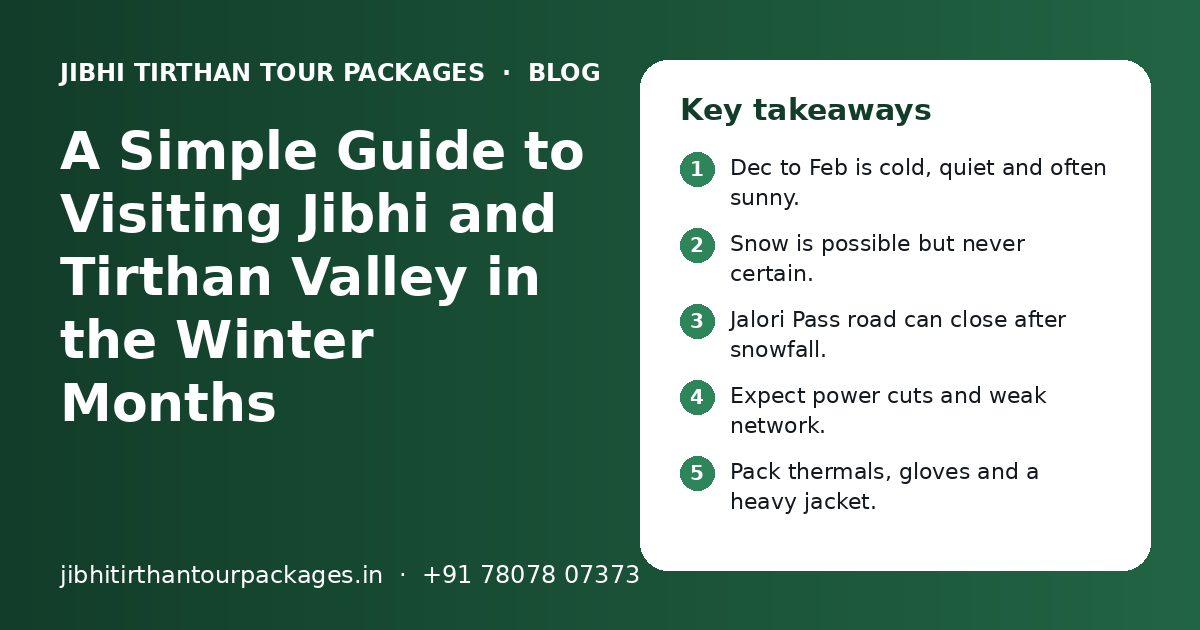
Key takeaways
- Dec to Feb is cold, quiet and often sunny.
- Snow is possible but never certain.
- Jalori Pass road can close after snowfall.
- Expect power cuts and weak network.
- Pack thermals, gloves and a heavy jacket.
- Keep one spare day in your plan.
What is Jibhi like in winter?
Jibhi in winter is cold, calm and slow. Days are often sunny and pleasant, while mornings and nights are very cold, and some days bring snow or rain.
Jibhi is a small village in the Banjar area of Kullu district in Himachal Pradesh, set among pine and deodar forest close to the Tirthan Valley. In winter it becomes still. Fewer cars come up and the hills look sharp and clear.
Month by month in winter
| Month | What it is usually like | Good to know |
|---|---|---|
| December | Cold and mostly dry, clear skies on many days | Christmas and New Year weeks get busy |
| January | Often the coldest month, snow is more likely | Roads to higher spots may close after snow |
| February | Still cold, snow possible early in the month | Days slowly get a little warmer |
If you want to compare all seasons, read our full guide on the best time to visit Jibhi. This post looks only at the winter months.
Does it snow in Jibhi and Tirthan Valley in winter?
It can, but snow is never certain. Jibhi village gets snow on some winters and some days, while higher places like Jalori Pass get snow much more often.
Snowfall depends on the year and on western weather systems that bring cloud and cold air to Himachal. Some years Jibhi gets a good white cover in January. Other years it stays mostly dry, and you only see snow on the peaks around you. The Tirthan Valley side is lower in many parts, so snow there is less common.
How to raise your chances of seeing snow
- Plan for January or early February, when snow is more likely.
- Watch the forecast for a snowfall spell a week before you go.
- Keep your dates a little flexible if you can.
- Stay two or three nights, so one snow day has a chance to come.
- Ask about a drive towards Jalori Pass, if the road is open and safe.
Please do not plan a trip only for snow. Go for the quiet, the forest and the views. If snow comes, it is a bonus.
Is the Jalori Pass road open in winter?
Often not after heavy snow. The road over Jalori Pass, which is over 3,000 metres high, is often closed or tricky after snowfall in winter, so check the latest official update before you go.
Jalori Pass sits above Jibhi on the road towards Shoja and the Seraj side. After snowfall, the road can stay closed for days or longer until it is cleared and safe. Even when it is open, shady bends can stay icy. Local drivers know these spots well.
- 1
Check the forecast
Look at the weather for Jibhi and Jalori Pass three to four days before you leave.
- 2
Check the road status
Look for the latest official update on the Jalori Pass road, and ask your stay or driver on the day.
- 3
Go only as far as is safe
Many visitors drive up to where the road is open, enjoy the snow there and return.
- 4
Turn back early
Come down well before dark. Ice gets worse in the evening.
- 5
Have a backup plan
If the road is closed, plan a village walk, a waterfall or the Tirthan side instead.
The Serolsar Lake walk from Jalori Pass is mainly a spring to autumn plan. In deep snow it may not be safe or possible. Read our Jalori Pass and Serolsar Lake trek guide for the normal season.
What can you do in Jibhi in winter?
You can enjoy slow village walks, sunny afternoons, forest views, local food, bonfire evenings where allowed, and a snow drive towards Jalori Pass when the road is safe.
Winter is a season for rest, not big adventure lists. Most of the fun comes from simple things done slowly.
Village and forest walks
Walk in the sun in the late morning and early afternoon, when it is warmest.
Jibhi waterfall
A short visit is nice, but paths can be icy. Wear shoes with grip.
Chehni Kothi
The old tower village near Jibhi. The walk can be slippery after snow, so ask locally first.
Tirthan side drive
A calm day by the river in the Tirthan Valley, often a little milder.
Snow at Jalori
A drive up as far as is safe, only when the road update allows it.
Cosy stay time
Books, board games, hot food and long talks by the heater.
For a full list for every season, see things to do in Jibhi and our guide to places to visit in Tirthan Valley.
How cold does Jibhi get, and how do you stay safe?
It gets very cold, especially at night and early morning, and it can drop below freezing on many winter nights. Warm layers, a heated room and careful road plans keep you safe.
The cold in the hills feels sharper than in the plains. Sun makes the day feel fine, but once the sun goes behind the hill, the cold comes fast. Water pipes can freeze on some cold nights in some stays.
Cold and health safety
- Wear layers: thermal, then a fleece or sweater, then a heavy jacket
- Keep head, hands and feet warm with a cap, gloves and wool socks
- Drink warm water through the day, even if you do not feel thirsty
- Never sleep with a coal or wood fire burning inside a closed room
- Ask your stay how the room is heated and keep some air flowing
- Carry basic medicines for cold, cough and fever
Road safety in winter
- Finish hill driving before it gets dark
- Do not self-drive on snow or ice if you have no experience
- Hire a local cab with a driver who knows winter roads
- Ask about snow chains for the drive towards Jalori
- Keep one spare day in case a road closes
Our how to reach Jibhi guide explains bus and car options. For more common errors, read our post on Jibhi trip mistakes to avoid.
Need help with your project?
Talk to the Jibhi Tirthan Tour Packages team. Free first call, simple advice, clear quote.
Are power cuts and network problems common in Jibhi in winter?
Yes, they can happen. Snow, wind and rain can cause power cuts, and mobile data can be slow or drop for some hours.
Most stays manage, but backup varies. Some have an inverter or generator for lights and charging. Heaters may not run on backup power. UPI can fail when the network drops, and the few ATMs nearby may not always work.
| Issue | What can happen | What to do |
|---|---|---|
| Power cut | No heater or geyser for some hours | Ask about power backup and carry a power bank |
| Weak network | Calls drop and UPI fails | Carry cash and two SIMs if you can |
| Frozen pipes | Less running water on very cold mornings | Ask the stay how they handle it |
| No maps | Live maps stop loading | Download offline maps before you leave |
If you plan to work from the hills, read our Jibhi workation guide before you book.
What should you pack for Jibhi in winter?
Pack warm layers, gloves, a woollen cap, wool socks, shoes with grip, a power bank, a torch and cash. Plan for cold that is much stronger than in the plains.
- Thermal top and bottom, two sets
- Fleece or thick sweater, and a heavy jacket
- Woollen cap, gloves, muffler and wool socks
- Waterproof shoes or boots with good grip
- Lip balm, moisturiser and sunscreen, as winter sun is strong
- Power bank, torch and spare batteries
- Basic medicines and any personal medicines
This is a short winter list. For a full list for every season, see our Jibhi packing list.
Who is a winter trip to Jibhi good for?
Winter suits couples, small families, friends groups and quiet workations, as long as everyone is fine with cold and a slow pace.
Winter suits you if
- You want quiet, fewer crowds and clear views
- You enjoy cosy stays, warm food and slow days
- You hope to see snow and are fine if it does not come
- Your dates are a little flexible
Think twice if
- You want to do the Serolsar Lake walk or long treks
- Someone in your group cannot handle strong cold
- You have very fixed dates and a tight plan
- You need steady power and internet every hour
Tips by group
- Couples: pick a stay with a good heater and a view. See our Jibhi honeymoon package.
- Families: pick a stay near the road and keep kids extra warm. See our Jibhi family tour package.
- Friends groups: share a cab with a local driver and avoid late evening drives.
- Workations: confirm power backup and network at the stay before you book.
Winter vs other seasons: how is Jibhi different?
Winter gives you quiet days, cold nights and a chance of snow. Other seasons are better for treks and long days outside.
| Season | Weather | Crowd | Good for | Watch out for |
|---|---|---|---|---|
| Winter (Dec to Feb) | Cold, often sunny, snow possible | Low, except holiday weeks | Cosy stays, snow views, rest | Road closures, power cuts, ice |
| Spring (Mar to Apr) | Cool and fresh | Medium | Walks and early treks | Leftover snow up high |
| Summer (May to Jun) | Pleasant days, cool nights | High | Treks, Jalori, Serolsar Lake | Weekend traffic |
| Monsoon (Jul to Sep) | Rain and green hills | Low | Green views, quiet | Landslides and slow roads |
| Autumn (Oct to Nov) | Clear and crisp | Medium | Views, treks, photos | Cold nights start |
For the full season comparison, see our best time to visit Jibhi guide. For a sample plan you can adjust for winter, read our 3 days in Jibhi itinerary.
How can we help you plan Jibhi in winter?
Share your dates and group size, and we can plan a winter trip around the weather, road updates and your pace, with a clear quote.
Jibhi Tirthan Tour Packages plans trips to Jibhi and the Tirthan Valley: packages, stays, cabs, sightseeing, treks and custom itineraries. In winter, we keep plans simple and flexible.
- Tell us your dates, group size and where you start from.
- Tell us what matters most: snow, quiet, comfort or work.
- We suggest stays with heating and easy access, plus a cab with a local driver.
- We keep a backup plan in case Jalori Pass road is closed.
- You get a trip plan and a clear quote for your dates.
Season, group size, vehicle, stay type and number of days all change the cost. Our Jibhi trip cost guide explains this. Browse our Jibhi tour package, then call or WhatsApp +91 78078 07373.
Frequently Asked Questions
Is Jibhi open in winter?
Yes. Jibhi village stays open in winter, and many homestays and cottages take guests from December to February. Some smaller places may close for a few weeks, so confirm before you book. The road to Jibhi is usually used through winter, but heavy snow can slow it for a while. Higher roads like the Jalori Pass road can close after snowfall.
Which month is best to see snow in Jibhi?
January and early February usually give the best chance of snow, but it is never certain. Some winters bring good snow in Jibhi village, while others stay dry with snow only on the peaks and higher spots like Jalori Pass. Watch the forecast a week before you travel and keep your dates a little flexible if snow matters to you.
Can we go to Jalori Pass in January?
Sometimes, but it depends on the snow. After heavy snowfall the Jalori Pass road is often closed or icy for days. When it is open, many visitors drive up as far as is safe, enjoy the snow and come back before dark. Check the latest official update before you go and follow your driver's and local advice.
Is Jibhi in winter good for a honeymoon?
Yes, many couples enjoy Jibhi in winter. It is quiet, the views are clear and a warm cottage feels very cosy. Pick a stay with a reliable heater and ask about power backup. Keep the plan slow, with short walks in the sun and relaxed evenings. Snow is a bonus if it comes, not something to count on.
Is it safe to take kids and older parents to Jibhi in winter?
It can be, with good planning. Keep everyone in warm layers, pick a heated stay close to the road and avoid long drives after dark. Hire a local cab with an experienced driver instead of self-driving on snow. Carry basic medicines, and keep one spare day in case roads close or someone needs rest.
How many days are enough for Jibhi in winter?
Three to four nights is a good length for most winter trips. It gives you time to rest after the long drive, enjoy a few short walks and keep one spare day for weather. If you also want a calm day in the Tirthan Valley or hope to catch a snow day, add one more night.